KPV: The Complete Guide to the Alpha-MSH Tripeptide
KPV is a peptide composed of three amino acids: lysine, proline, and valine. It incorporates the end of alpha-MSH, a hormone known for its role in pigmentation and inflammation. Here's what it is, how it works according to studies, what research has measured, and its current status.
What is KPV?
KPV is a tripeptide: a chain of three amino acids, lysine (K), proline (P), and valine (V). Its name simply uses their letters. It corresponds to the last three amino acids of alpha-MSH, the hormone that stimulates melanocytes, hence its other name: alpha-MSH(11-13).
- Molecule: Lys-Pro-Val, formula C₁₆H₃₀N₄O₄, mass of approximately 342.4 g/mol.
- Origin : It is a fragment of alpha-MSH, a hormone made up of thirteen amino acids.
- No pigmentation effect: It retains the anti-inflammatory effect of the parent hormone, but not its action on skin color.
- No authorization: No medication containing KPV is authorized, either in Europe or in the United States.
Alpha-MSH, the hormone from which it comes
Alpha-MSH is produced from a large precursor protein, pro-opiomelanocortin. It pigments the skin by stimulating melanocytes, but it also inhibits inflammation. As early as the 1980s, researchers sought to determine which part of the molecule was responsible for this effect. In 1984, in rabbits, the tripeptide 11-13 reduced fever, though less strongly than the entire hormone. In 1989, in mice, it reduced ear swelling caused by an allergic contact reaction.
The interest of KPV lies in this separation: a 2008 review presents it as an anti-inflammatory approach that does not have the pigmentary effect of alpha-MSH, which limited the use of the whole hormone in research.
How does KPV work?
The studies describe three elements, in cells and in mice:
- The brake on NF-κB: KPV blocks the activation of NF-κB, a central switch of inflammation. In cultured human bronchial cells, it enters the nucleus and prevents the arrival of the p65 protein, thereby reducing the production of inflammatory signals.
- The PepT1 transporter: In the intestine, KPV enters cells via PepT1, a small peptide transporter. This transporter is mainly present in the small intestine, and it appears in the colon in cases of inflammation.
- Melanocortin receptors: Their role is debated. Several studies have found an effect largely independent of these receptors: KPV does not bind to them and does not increase cAMP in macrophages, and it still acts in mice without a functional MC1 receptor. However, in cells that express the MC1 receptor, it triggers a calcium signal.
The question of its exact target is therefore not settled: a 2006 study still describes it as an anti-inflammatory sequence without a known cellular target.
What research shows
All published studies were conducted on cells or animals. No human trials have been published.
| Axis | Model | Main result |
|---|---|---|
| Intestine | Mice with colitis (Dalmasso et al., 2008; Kannengiesser et al., 2008) | Less inflammation and faster recovery |
| Skin | Cultured human keratinocytes; mouse, contact skin reaction | Fewer inflammatory signals; reduced swelling |
| Eye | Rabbits, damaged cornea (Bonfiglio et al., 2006) | Faster healing of the eye surface |
| Brain | Mouse, head trauma (Schaible et al., 2013) | Smaller secondary lesion |
| Germs | Staphylococcus and yeast cultures | Reduced in vitro growth |
The details of each study, including its limitations, can be found on the page benefits of KPV.
The forms studied
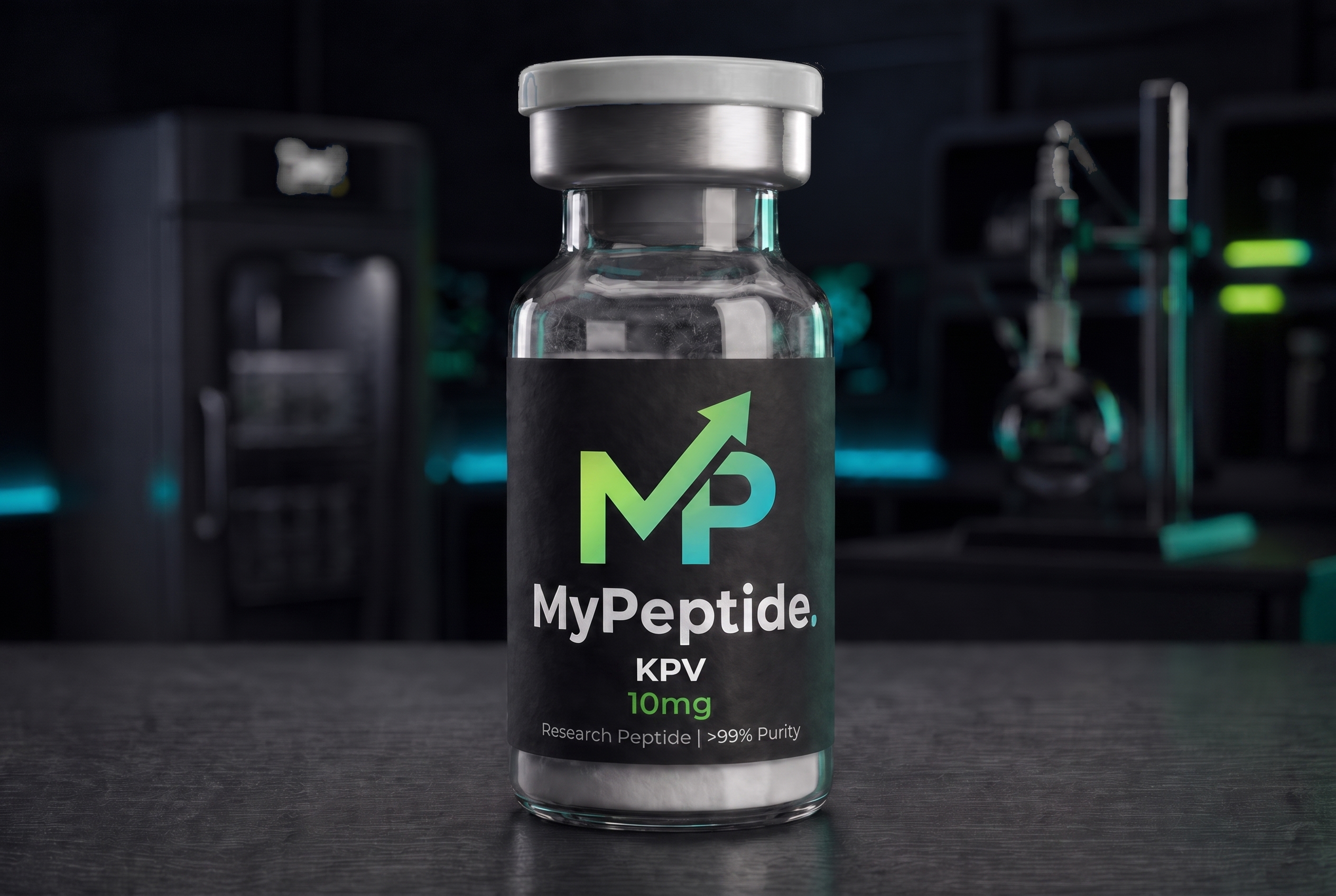
The KPV sold to laboratories comes as a freeze-dried powder in a vial. Studies in mice have used several routes: in drinking water, in ingested nanoparticles, by injection, or by application to the eye. Capsules sold as supplements have not been the subject of any published studies. The page KPV oral or injectable compares these forms.
KPV status in 2026
KPV is not approved as a drug in any country. In April 2026, the FDA stated that it had identified no human exposure data for KPV and lacked information on its safety. However, in July 2026, an FDA advisory committee recommended, against the advice of the agency's staff, that it be authorized for use in preparations by US pharmacies. In late October 2026, the US Department of Health and Human Services issued a provisional policy that tolerates these preparations under certain conditions, pending a decision from the FDA. This policy applies only to the United States.
In Europe, KPV is not authorized as a medicine; it is sold as a research peptide. For sports, it falls under class S0 of the World Anti-Doping Agency, the category of unapproved substances. Details can be found on the page side effects and status.
Our KPV 10 mg
MyPeptide sells KPV in 10 mg lyophilized vials for €59.90, or €5.99 per mg. The batch for sale was analyzed by Janoshik: 11.07 mg of KPV were measured, with a purity of 98.8%. Report #248290 is detailed on the page KPV COATracked delivery within 2 to 5 business days from the EU, €10, free for orders over €160. Payment by credit card (Visa), Apple Pay or Google Pay.
- Benefits: what studies say
- Oral or injectable KPV: the forms studied
- KPV or BPC-157: the differences
- Side effects and status
- Our Janoshik (COA) analysis
- KLOW, a mixture that contains KPV
Frequently asked questions
What is KPV?
A tripeptide of three amino acids: lysine, proline, and valine. This is the end of alpha-MSH, a hormone that acts on pigmentation and inflammation.
What does KPV mean?
These are the letters of the three amino acids in the international code: K for lysine, P for proline and V for valine.
Is KPV a medication?
No. No medication containing KPV is authorized in either Europe or the United States. MyPeptide sells it as a research peptide.
How does KPV work?
In cells and in mice, it inhibits NF-κB, an inflammation switch. In the intestine, it enters cells via the PepT1 transporter.
Does KPV cause tanning?
No. Unlike whole alpha-MSH, KPV has no pigmentary effect reported in studies.
Has KPV been tested on humans?
No. The published studies are based on cells and animals. The FDA states that it has not identified any data on human exposure.
What is the difference between KPV and alpha-MSH?
Alpha-MSH contains thirteen amino acids and affects skin color. KPV retains only the last three and mainly retains the hormone's anti-inflammatory effect.
Is there an established dosage for KPV?
No. No human studies exist, so no dosage has been established. MyPeptide does not provide any usage advice.
Is KPV part of KLOW?
Yes. KLOW is a mixture of four peptides: GHK-Cu, BPC-157, TB-500, and KPV. The KLOW guide describes this mixture.
Where can I find analyzed KPV?
MyPeptide sells KPV 10 mg for €59.90. The batch for sale was analyzed by Janoshik: 11.07 mg measured, 98.8% purity, report #248290.
Sources: Richards and Lipton, Peptides 1984; Hiltz and Lipton, FASEB J 1989; Mandrika et al., Biochem Pharmacol 2001; Getting et al., J Pharmacol Exp Ther 2003; Elliott et al., J Invest Dermatol 2004; Schiöth et al., Basic Clin Pharmacol Toxicol 2006; Bonfiglio et al., Exp Eye Res 2006; Dalmasso et al., Gastroenterology 2008; Kannengiesser et al., Inflamm Bowel Dis 2008; Brzoska et al., Endocr Rev 2008; Land, Int J Physiol Pathophysiol Pharmacol 2012; Schaible et al., PLoS One 2013; FDA, substances for compounded preparations (April 2026); US Department of Health policy dated 30/10/2026; World Anti-Doping Agency, Prohibited List; Janoshik Report #248290. MyPeptide products are intended exclusively for scientific laboratory research.